

Back to Basics: How Breath, Sound and Subtle Movement Help Us Connect With Our Body
By Debbie Wyer on 24 September 2026
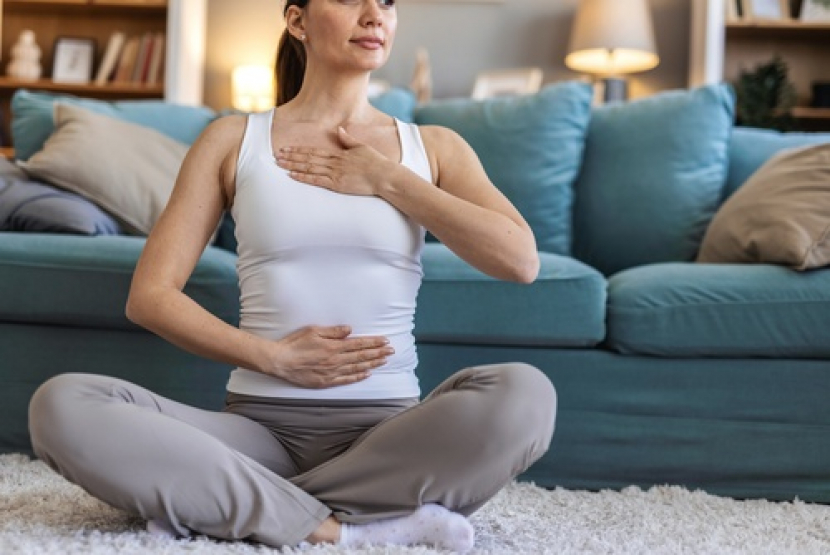
Sometimes the smallest things can make the biggest difference.
When we think about progressing our exercise, it's easy to assume that we need to do more. Add more resistance, make the movement bigger, increase the load or find a harder exercise but sometimes progress comes from doing the opposite.
Going back to basics gives us an opportunity to slow things down and notice what's actually happening in our body before we make a movement more complicated.
It's something I regularly revisit in my own training too. Continuing my education with MELT, Pilates, biomechanics and meditation isn't always about learning more advanced techniques. Revisiting the foundations, asking questions and refining my understanding can be just as valuable.
Because subtle doesn't mean insignificant.
Starting from the ground up
One of the places I like to begin is with our feet.
Our feet are our connection with the ground and are packed with sensory receptors continually providing information to the nervous system about pressure, position and where we are in space.
So, what happens at your feet doesn't necessarily stay at your feet.
After a MELT foot treatment, for example, you may sense more connection with the ground and notice that something feels different further up your body too.
That's why we assess before a treatment and then reassess afterwards.
If we don't take the time to notice how we feel before we start, we might completely miss those subtle changes.
And that idea of noticing first applies to much more than our feet.
What can you feel when you breathe?
Breathing is something we do all day, every day, usually without giving it much thought, but stop for a moment and notice your breath. Rather than deliberately taking a big breath, notice where your breath naturally moves.
What can you feel? Can you feel your chest and abdomen gently expand as you breathe in and release as you breathe out? Can you feel the back of your body expand? Can you feel your ribs widening out towards the sides?
And are your shoulders trying to join in and do some of the work?
The diaphragm isn't just at the front of your body. It's a three-dimensional muscle with attachments around the lower ribs, sternum and spine, so breathing is a three-dimensional movement too.
Sometimes simply bringing attention to where the breath is, or isn't moving can give us some really useful information.
You may even notice muscles responding in places you weren't expecting.
Once we become more aware of the breath and diaphragm, we can explore what happens when we add sound to the exhale.
This is something I use in my classes to explore the relationship between breath, pressure and the muscles of the trunk and pelvic floor.
As you breathe out, the diaphragm relaxes and rises. At the same time, the abdominal wall and pelvic floor can respond as part of the coordinated system that manages breathing, pressure and movement.
Rather than deliberately pulling your tummy in or trying really hard to activate your core, we use a sustained sound as you breathe out.
Then we pay attention to what we can feel. Perhaps it's a subtle sensation deep in the pelvic floor. Perhaps you sense the lower abdomen responding. Perhaps it feels almost like a gentle hug around the organs or a connection that's quite difficult to put into words.
Using sound to explore this response isn't something that's only found within MELT. Researchers have studied phonation, the production of sound, and its relationship with muscular activity. Research using ultrasound has found changes in deep abdominal muscle recruitment during sustained phonation. More recently, a 2026 study found increased pelvic-floor muscle activity when healthy young women produced different sounds.
Importantly, that research wasn't testing the exact sounds I use in class, but it does give us an interesting insight into the relationship between breath, sound and how our body responds.
And that brings me back to something I love exploring:
Instead of always consciously telling your body what to contract, what happens if we give it a stimulus and notice how it responds?
Your core isn't something you need to hold tight all day
We're often told to engage the core, pull the tummy in or brace, but our core is designed to respond.
The diaphragm, abdominal wall and pelvic floor work together and respond to breathing, movement and changes in pressure. That means we don't necessarily need to spend our day consciously holding everything tight.
Sometimes we can do a little less and become more aware of what our body is already doing.
Breath can change more than movement
Breathing isn't only relevant when we're exercising. Our breathing and our nervous system are closely connected. Think about what happens when you're frightened, stressed or rushing. Your breathing can change without you consciously deciding to change it, but we can also deliberately change the way we breathe.
Slowing down, becoming aware of the breath or gently lengthening the exhale can influence how we feel.
It's one of the reasons breath runs through so much of what I teach – Pilates, MELT and meditation.
How am I breathing today?
Back to basics doesn't mean easy. We sometimes hear the word basic and assume it means easy. They're not the same thing.
How often do you really notice your breathing?
Do you notice when you're holding your breath?
Gripping your jaw?
Lifting your shoulders?
Or unnecessarily holding tension through your tummy?
Going back to basics gives us an opportunity to reconnect with those things.
Whether you've been doing Pilates for twenty years, you've only just started, or you've never stepped into a Pilates studio, developing greater awareness of your own body can be incredibly valuable.
Because my aim isn't simply to help people become better at Pilates.
I want to help people become more connected to their own body to notice when something changes, recognise when they're holding unnecessary tension and have simple tools they can use in everyday life to help themselves.
So try something very simple today.
Every now and again, stop for a moment and ask yourself:
How am I breathing right now?
You don't necessarily need to change it.
Start by noticing it.
At Debbie Wyer Pilates, you’ll find thoughtful movement, expert guidance and a welcoming space to help you feel stronger, more comfortable and more confident in your body — through Pilates, MELT, meditation and wellbeing.
Latest Blog Posts
- Lower Body Compression - Back Thigh, Calf & Inner Thigh 02 October 2026
- Back to Basics: How Breath, Sound and Subtle Movement Help Us Connect With Our Body 24 September 2026
- Taking MELT to CarFest: What an Incredible Weekend 10 September 2026
Useful Links
2026 © All Rights Reserved. Powered by V-Healthy. Privacy Policy | Terms of Service