

Why Vibration Matters: Understanding the MELT Fascial Hydrator
By Debbie Wyer on 13 August 2026
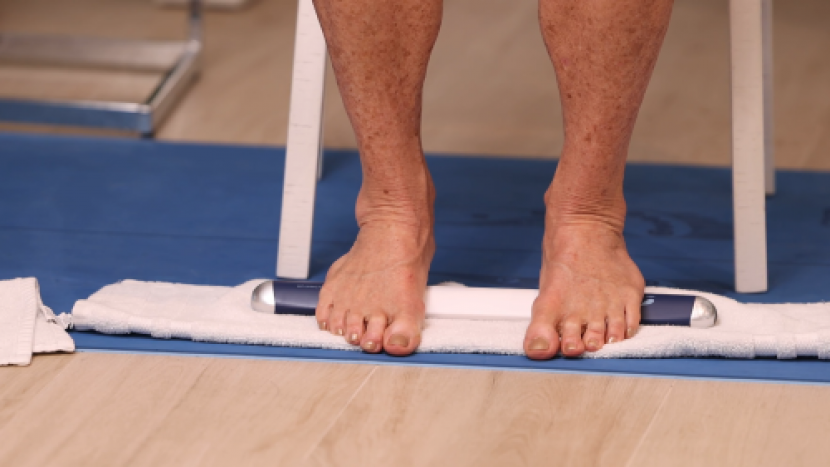
If you've been coming to my classes recently, you may have noticed me using a rather unusual-looking piece of equipment - the MELT Fascial Hydrator
It has already caused a few raised eyebrows, some interesting questions and a fair amount of curiosity!
I've been using it myself since last August and, over the last couple of months, I've also started introducing it into some of my classes.
One of the things I love about using it is that we don't just do something and move on. We stop, notice how the body feels, use the Hydrator and then Rest, Assess & Reassess.
And quite often, people notice a difference surprisingly quickly.
What is the Fascial Hydrator?
The MELT Fascial Hydrator is a frequency-based extension of the MELT Method. It uses gentle vibration at different frequencies to provide stimulation to the body.
Rather than thinking about it as something that is going to "fix" a particular problem, I think of it as another tool for helping us connect with our bodies, create awareness and support the body's natural processes.
This fits beautifully with the way I already teach Pilates and MELT.
I'm much more interested in helping you understand what you are feeling and why, rather than simply telling you what you should do.
So why frequency?
Frequency is simply the rate at which something vibrates.
Think about sound. A low musical note vibrates at a different frequency from a high musical note. We don't need to understand the physics to know that they feel and sound different.
Our bodies are also constantly experiencing movement and vibration from our heartbeat and breathing to walking, running, talking and even the movement of fluid through our tissues.
The interesting question is whether we can deliberately introduce different forms of vibration and whether the body responds differently depending on the frequency used.
This is an area I've become increasingly fascinated by. I've read books including The Resonance Effect by Carolyn McMakin, Tuning the Biofield by Eileen Day McKusick and The Biology of Belief by Dr Bruce Lipton, all of which have encouraged me to think differently about the relationship between our environment, our bodies and the signals we give them.
And vibration itself isn't anything new. For thousands of years, humans have used rhythm, sound and vibration as part of practices designed to calm, connect and regulate from drumming and chanting to music and sound healing.
Modern medicine also uses sound and vibration in very different contexts. Ultrasound, for example, is used in a number of medical applications, including breaking up kidney stones and supporting bone healing.
What interests me is how we can explore gentle vibration as part of everyday wellbeing and body awareness.
What does fascia have to do with it?
Fascia is the connective tissue that surrounds, supports and connects structures throughout the body. It isn't just one thing or one layer. It forms a continuous network throughout us, surrounding muscles, bones, nerves, blood vessels and organs.
Fascia contains collagen, fluid and specialised cells called fibroblasts, amongst other components. And importantly, fascia isn't static. It responds to movement, pressure, load and different forms of mechanical stimulation.
This is one reason I find fascia so fascinating.
We're often taught to think about the body in separate parts:
"My hamstrings are tight."
"My shoulders are stiff."
"My lower back is the problem."
But the body doesn't really work in isolated sections. Everything is connected.
The Fascial Hydrator gives us another way of providing gentle stimulation to this interconnected system.
So what's with the different frequencies?
The Fascial Hydrator has different frequency settings, each designed to provide a different type of stimulation - 40 Hz, 70 Hz and 90 Hz, along with an oscillating setting.
The important thing to say here is that fascia doesn't simply have one frequency that it "needs" in order to be healthy.
It's much more complicated than that.
Instead, the different settings provide different types of vibrational input, and the MELT Method uses them for different purposes.
40 Hz – gentle rhythmic stimulation
Within the MELT approach, this setting is used to support fluid movement and lymphatic stimulation, as well as sensory awareness. It can also be a lovely way of bringing attention into the body.
70 Hz – working with the tissues
Within the MELT Fascial Hydrator approach, this frequency is associated with supporting fascia hydration and the health and adaptability of connective tissue.
90 Hz – a different type of stimulation
Within MELT, it is used for purposes including supporting recovery and gentle lymphatic "rinsing".
And then there's the oscillation
This is probably one of my favourites. Rather than simply vibrating at one frequency, the Hydrator can create an oscillating wave pattern.
The oscillation is slower and more rhythmic, and within the MELT approach it is used alongside breathwork and relaxation.
This is where vibration becomes particularly interesting from a nervous-system perspective. Our breathing and heart rate are constantly changing. We aren't machines ticking along at exactly the same rate all day. Think about how quickly a piece of music can change your mood or how calming repetitive movement can feel.
The aim isn't to "switch off" your nervous system. It's about giving your body different sensory information and creating the opportunity to slow down, breathe and notice.
What have I noticed?
I've been using the Fascial Hydrator regularly since last year and one of the most noticeable changes for me has been the texture of my skin.
My arms and legs feel smoother after using it and I've noticed a difference in how my skin looks and feels. But perhaps more importantly, I've become much more aware of how my body responds to different types of stimulation.
I've also introduced the Hydrator into classes, and many clients have noticed changes surprisingly quickly during our Rest, Assess & Reassess.
Sometimes it's a feeling of release, more ease or simply feeling more relaxed or aware of a particular part of the body. And occasionally there are some very funny reactions when I first let people feel the different settings!
Some people notice a change immediately. Others don't notice very much at all. And that's okay.
That's why I love the Rest, Assess & Reassess approach.
Rather than me telling you what you should feel, we pause and check in with your body before and after.
Over time, the more you practise noticing, the easier it can become to recognise those little changes perhaps a muscle feels less tense, a movement feels easier or you simply feel more comfortable in your body.
Want to experience the Fascial Hydrator?
I'm holding an Introduction to the Fascial Hydrator session in September.
Saturday 19 September 2026
9.15am – 10.30am
£25
We'll look at what the Fascial Hydrator is, explore the different settings and, most importantly, give you the opportunity to experience what they actually feel like.
No previous MELT experience is needed.
If you'd like to find out more or book your place, click here or go to the pricing page and scroll down.
A quick note about using the Fascial Hydrator
The Fascial Hydrator isn't suitable for everyone. If you have any health concerns or are unsure whether it is appropriate for you, please contact me before booking or using the Hydrator. There are circumstances where it may not be appropriate, including having a pacemaker, active cancer, DVT or being pregnant.
If you're unsure, please ask. I'm always happy to chat through any concerns with you first, The more I learn about fascia, vibration and our nervous system, the more fascinated I become by just how clever our bodies are.
Your body is constantly communicating with you.
The more we learn to listen, the more we can understand.
Understand your body. Move with confidence. Thrive for life.
At Debbie Wyer Pilates, you’ll find thoughtful movement, expert guidance and a welcoming space to help you feel stronger, more comfortable and more confident in your body — through Pilates, MELT, meditation and wellbeing.
Latest Blog Posts
- Taking MELT to CarFest: What an Incredible Weekend 10 September 2026
- Why Vibration Matters: Understanding the MELT Fascial Hydrator 13 August 2026
- Find Calm in Just 30 Minutes 02 August 2026
Useful Links
2026 © All Rights Reserved. Powered by V-Healthy. Privacy Policy | Terms of Service